
Hope is here with Kisunla
An anti-amyloid treatment that can slow the progression of early symptomatic Alzheimer’s disease (AD)
Actor Portrayals.
Actor Portrayals.
Hope is here with Kisunla
An anti-amyloid treatment that can slow the progression of early symptomatic Alzheimer’s disease (AD)
It’s possible to significantly reduce amyloid plaques associated with early symptomatic AD when taking Kisunla
Kisunla is for adults with early symptomatic AD, which includes mild cognitive impairment (MCI) or mild dementia stage of disease.
In a clinical study at 18 months, people treated with Kisunla showed a significant reduction in amyloid plaques compared with those who were given placebo.
Kisunla can slow the progression of early symptomatic AD, which presents with memory and thinking issues
While Kisunla cannot reverse or stop existing memory and thinking issues that are due to early symptomatic AD, it can help slow the progression of the disease.
After 18 months in a clinical study, people treated with Kisunla showed a significant slowing of decline of 22%, on average, compared with placebo.
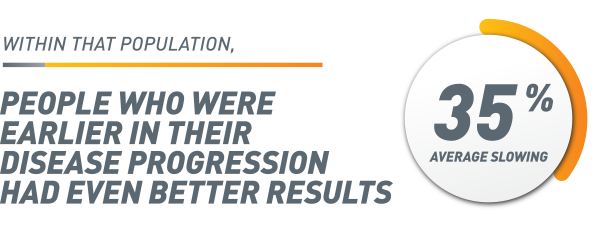
Image showing that, within that population, people treated with Kisunla who were earlier in their disease progression had even better results—35% average slowing.
The study population had varying levels of tau, a protein in the brain associated with AD. A higher amount of this protein is thought to be a factor in determining how far along a person is in the disease progression.
SELECT SAFETY INFORMATION
Kisunla can cause Amyloid-Related Imaging Abnormalities, or “ARIA.” ARIA is a common but serious side effect that does not usually cause any symptoms, but can be serious. ARIA can be fatal. ARIA is most commonly seen as temporary swelling in an area or areas of the brain that usually goes away over time. Some people may also have spots of bleeding on the surface of or in the brain and infrequently, larger areas of bleeding in the brain can occur.
For those with early symptomatic AD
Kisunla can help lower the risk of progressing to the next stage of AD
In a clinical study, people treated with Kisunla had a 37% lower risk of progressing to the next stage of disease through 18 months compared with those taking placebo.
Understanding the symptomatic stages of AD
Learn some of the signs and symptoms of each stage—and at which stage Kisunla can help

Early Stage: Mild Cognitive Impairment (MCI) or Mild Dementia

This is when Kisunla may be right for you.
You may notice small changes–like forgetting names or losing your train of thought–but you're still able to take care of yourself and live independently. Loved ones can help support you and motivate you to take action.
Because Kisunla is a treatment for the early symptomatic stage of AD, don’t wait to take the first step. Talk to your doctor about how Kisunla can help.
Middle Stage: Moderate AD
Daily routines will become harder to manage alone. Support from loved ones becomes more important in helping you stay safe and engaged as you may be confused more often and tend to wander or get lost.
Late Stage: Severe AD
With memory and thinking issues becoming more severe, you will depend on others for everyday tasks like eating, dressing, or getting around. Loved ones will often take on a larger caregiving role during this time, offering daily support and care.
Kisunla is not indicated to treat middle and late stages of AD.
Treatment options are available, including therapies that target symptoms such as memory, thinking, behavior, and mood.
SELECT SAFETY INFORMATION
(ARIA, continued) Kisunla can cause Amyloid-Related Imaging Abnormalities, or "ARIA." Although most people do not have symptoms, some people have headache, dizziness, nausea, difficulty walking, confusion, vision changes, and seizures. Call your healthcare provider or go to the emergency room right away if you have any of these symptoms. You should carry information that you are receiving Kisunla, which can cause ARIA, and that ARIA symptoms can look like stroke symptoms.
It’s possible to complete a treatment course with Kisunla in as early as 6 months
Your doctor may consider completing your Kisunla treatment course if your amyloid plaque levels are reduced to minimal levels*
In a clinical study, 17% of people were able to complete treatment course with Kisunla at 6 months, 47% at 12 months, and 69% at 18 months if their amyloid plaques were reduced to a predefined level.
PET scans were used to determine amyloid levels in the study. People who were able to complete their treatment course were switched to placebo.
Amyloid PET values may increase after completing treatment course with Kisunla. There are no data beyond the 18-month duration of the study to guide whether additional dosing with Kisunla may be needed for longer-term clinical benefit.
The long-term clinical benefit of Kisunla after completing treatment course has not been studied.
*Amyloid levels measured by PET scan.

Image showing that, 1 year without notable amyloid plaque reaccumulation is possible, and a calendar icon
Those who had no notable amyloid plaque reaccumulation 1 year after completing treatment were part of a small subset of the overall population and were less progressed in their disease.
A separate analysis showed that low amounts of amyloid plaque may reaccumulate per year after completing treatment course. The duration of efficacy beyond 76 weeks has not been established, as there are no data to inform whether additional dosing with Kisunla may be needed for longer-term clinical benefit.
SELECT SAFETY INFORMATION
(ARIA, continued) Kisunla can cause Amyloid-Related Imaging Abnormalities, or "ARIA." Some people have a genetic risk factor (homozygous apolipoprotein E ε4 gene carriers) that may cause an increased risk for ARIA. Talk to your healthcare provider about testing to see if you have this risk factor.
You may be at higher risk of developing bleeding in the brain if you take medicines to reduce blood clots from forming while receiving Kisunla. Talk to your healthcare provider to see if you are on any medicines that increase this risk.
Your healthcare provider will do magnetic resonance imaging (MRI) brain scans before and during your treatment with Kisunla to check you for ARIA.
Getting started with Kisunla
Stay in the know about Kisunla by subscribing to our emails